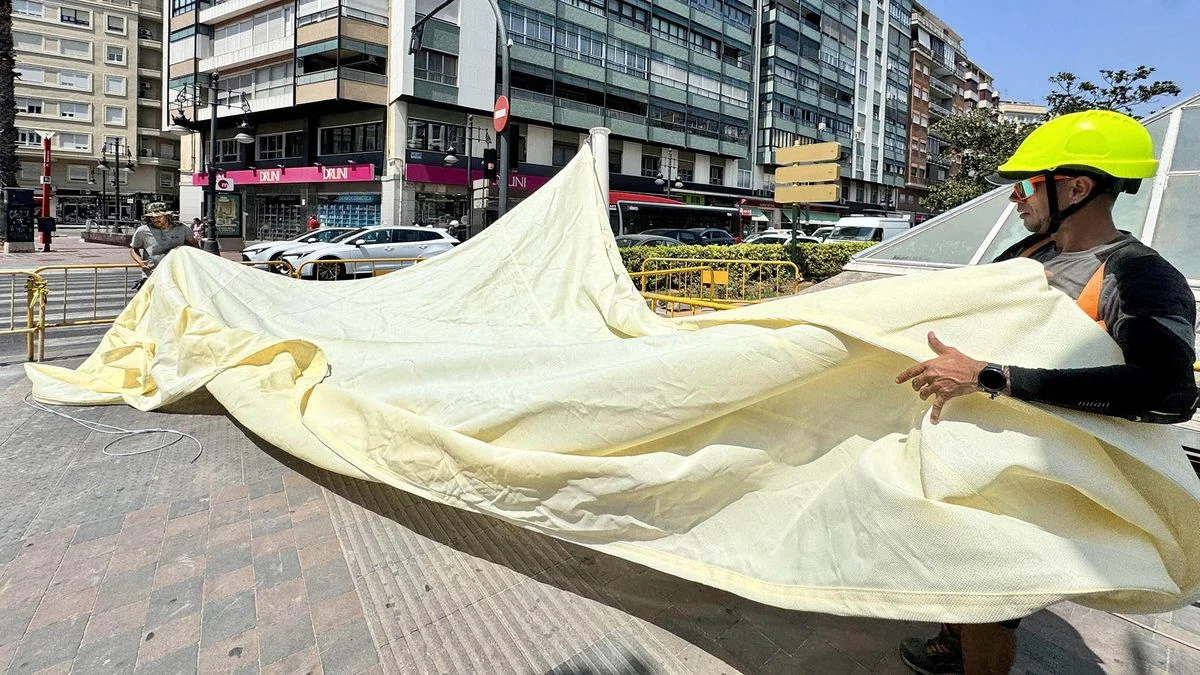
Valencia City Council has begun installing sun protection canopies in España and América squares. This is the pilot test of a study that will define structural solutions to generate shade throughout the city.
Valencia City Council started the installation of the first canopies in España and América squares on Tuesday. The sun protection canopies are being placed in waiting and pedestrian transit areas and will serve as a pilot test for the future shade plan being prepared by the municipal corporation.
The aim is to combat the increasingly persistent heatwaves in summer. The Councillor for Urbanism, Juan Giner, explained that these two new shaded areas are "the first step of a much more ambitious project" that will determine the best solution for creating shaded areas in all the squares of the city.
The study commissioned by the City Council, through a minor service contract, has a four-month execution period and will analyse unique squares and streets within the Valentia Plan, as well as other squares in all neighbourhoods of the city. The criterion for selecting locations will prioritise those with the highest solar impact.
The work is based on analysing references applied in other cities and a sunlight study of each location, taking into account the urban, technical, and heritage conditions of each place. From there, the study will propose the most suitable technical solutions and assess their costs, which include installation, assembly, disassembly, storage, and cleaning.
A structural response to heat
The installation of these canopies responds to a broader reflection that the Mayor of Valencia, María José Catalá, has recently raised: that all urban projects in the city incorporate design elements as a structural response to high temperatures and climate stress, rather than as a one-off solution.
In this line, the governing team is already applying three parameters in its interventions in public spaces: reducing noise and air pollution, creating shaded areas through the planting of large trees and expanding green areas, and improving playgrounds and accessibility as a cross-cutting criterion.
An example of this strategy is the future redevelopment of Sant Agustí square, whose works are nearing the final awarding phase. The project increases vegetation by planting 69 new trees and installing over 300 m² of solar protection pergolas.
The shade study also includes the delivery of a summary sheet for each location, with a work schedule extending from August to November 2026. The goal is for the subsequent deployment of shade solutions to have a homogeneous technical and regulatory framework, and for this, guidelines for a future municipal ordinance will be developed.
Residents of España and América squares can already see the installed canopies, and the City Council hopes this test will help evaluate their effectiveness before extending the measure to the rest of the city. The Urbanism Department and the Municipal Autonomous Organisation of Parks and Gardens are also working on drafting other shade area projects.
According to municipal sources, sound-absorbing asphalt, another of the measures applied, reduces noise by around ten decibels and nearly 20% of CO₂ emissions. These actions are part of the municipal strategy to incorporate climate protection elements into future urban developments.
The shade space study adds to other initiatives such as the planting of large trees, which aims not only to generate shade but also to improve air quality and reduce the heat island effect in neighbourhoods. The city of Valencia, with a Mediterranean climate, frequently records summer temperatures exceeding 35 degrees, making such interventions necessary.
The pilot test in España and América squares is the first visible step of a plan that, according to the councillor, "will allow us to determine the best solution for creating shaded areas in all the squares of our city." The results of the study will be known by the end of 2026, and from there, it will be decided how to extend shade solutions to other parts of the city.
Meanwhile, citizens passing through these two squares can already benefit from the new shaded areas, which have been placed in the most frequented and sun-exposed spots. The installation of the canopies is a temporary measure but is part of a long-term project aimed at making Valencia a more resilient city to climate change.
You may also like