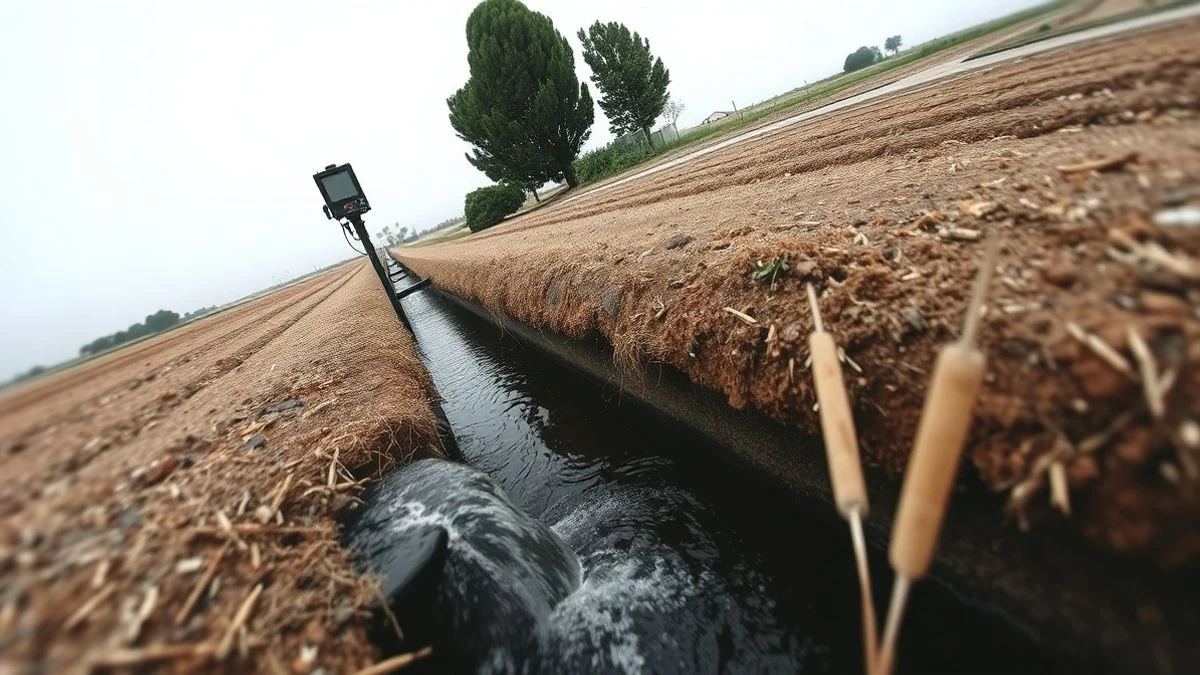
The Generalitat has installed a device in the San Vicente irrigation channel that will measure water parameters 24 hours a day. The aim is to tackle contamination episodes affecting the beaches of Port Saplaya and Meliana.
Alboraia and Meliana have launched a pilot project by the Generalitat Valenciana to monitor the quality of irrigation water in real-time. The system, called Water Biosense, has been installed in the San Vicente irrigation channel, one of the three pollution hotspots detected in the coastal area.
The device, located in the Alboraia section of the San Vicente irrigation channel, at its mouth between Port Saplaya and Meliana, will measure microbiological and physicochemical parameters of the water 24 hours a day. This will allow for the detection of which branch the contamination levels come from, at what times they occur, or if they coincide with irrigation, municipal sources explained.
The presentation of the system took place at a meeting with the third vice president and councillor for Environment, Infrastructure, Territory and Recovery, Vicente Martínez Mus, the mayor of Alboraia, Miguel Chavarría, and the mayor of Meliana, Trinidad Montañana.
A camera to monitor the Gaiato irrigation channel
In parallel, the Alboraia Town Council will install a camera at the end of the Gaiato irrigation channel, where it joins the Marquesa irrigation channel, the second pollution hotspot. This camera will record waste and will work alongside a probe placed at the beginning of the channel, which will provide data on the flow rate.
The aim is to locate possible discharges along the irrigation channel and to act quickly. These actions are part of the regular meetings that Alboraia holds with the Conselleria to address the issue of irrigation channel contamination, which particularly affects the northern beaches of Port Saplaya and Meliana.
The contamination comes from upstream
Alboraia already succeeded in September 2025, in one of the meetings with the Conselleria, in having the San Vicente irrigation channel analysed upstream. In the following weeks, samples were taken towards Vinalesa.
The result was a report from the Generalitat sent to several municipalities confirming that the source of the contamination episodes does not solely come from Alboraia. The document includes recommendations for action for each locality in order to stop the discharges.
More municipal measures
The Alboraia Town Council is also implementing other actions within its competencies. Urban planning is working on the installation of machinery to monitor the irrigation channel as it passes through the Industrial Estate and to control possible discharges from the warehouses.
Additionally, Alboraia has secured funding from EPSAR for pumping and diverting water, taking advantage of future works in the Tendetes area. The mayor, Miguel Chavarría, has also presented a project to divert the irrigation channel 150 meters north of the Peixets Camping site, the third hotspot, although it has not yet received the green light, as well as a project for an artificial wetland in Peixets, which has also been denied.
The implementation of these monitoring systems represents a further step in protecting the beaches and the natural environment of the area, and will allow for quicker solutions to future contamination episodes.
You may also like