The resurfacing works of Gran Vía Marqués del Turia have been completed ahead of schedule. The project, which cost 1.24 million, includes sound-absorbing pavement that will reduce noise and emissions.
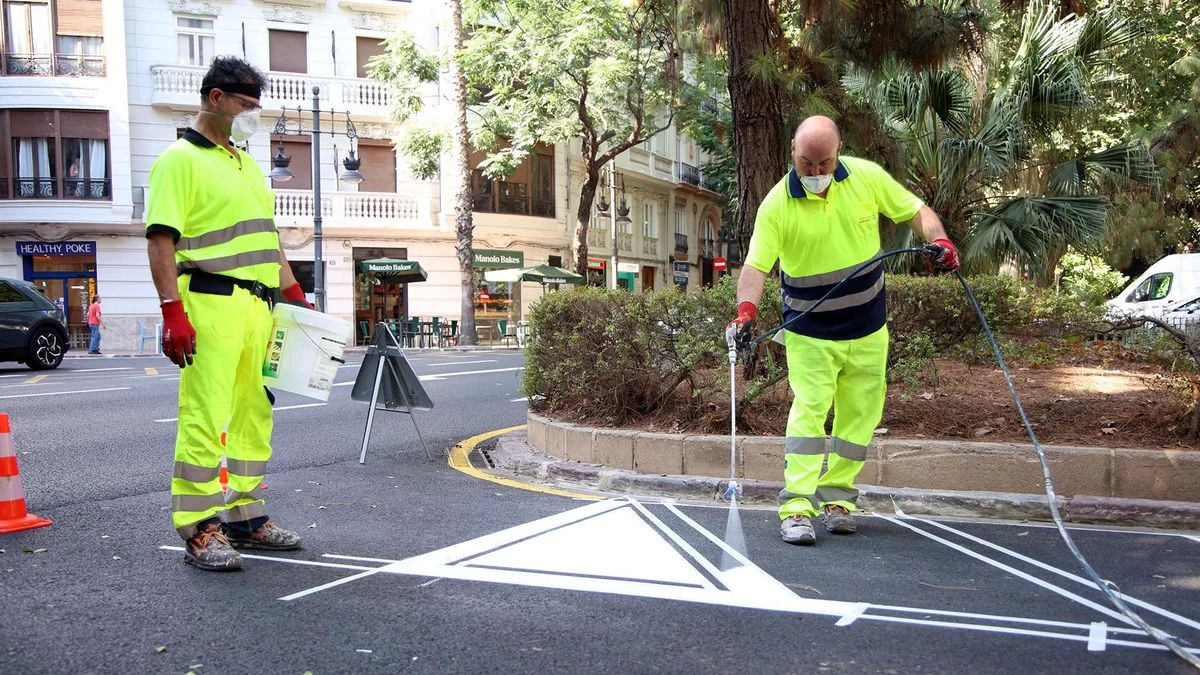
The Mayor of Valencia, María José Catalá, accompanied by the Urban Planning Councillor, Juan Giner, visited the completion of the comprehensive resurfacing works of Gran Vía Marqués del Turia this Thursday. The work, carried out ahead of schedule, has renewed one of the city's main urban axes after more than three decades without such an intervention.
The project, awarded to Pavasal for 1,240,614.21 euros, has covered 22,126 square meters of roadway in the section between Avenida de Jacinto Benavente and the junction of Avenida del Reino de Valencia with Calle Ruzafa. In addition, the City Council has allocated more than 1.8 million euros to modernise the infrastructure of the road, including the renewal of the sewage network, which involved an investment of over 646,000 euros.
“This was a necessary action on one of the busiest roads in Valencia. We wanted to use a safer and more sustainable pavement to improve the quality of life for the neighbourhood,” Catalá pointed out during the visit. The Mayor emphasised that the renovation “not only renews the asphalt but also provides more safety, reduces the acoustic impact of traffic, and makes Gran Vía a more comfortable and livable space.”
The new sound-absorbing pavement allows for a reduction of up to 10 decibels in traffic noise and reduces CO₂ emissions linked to traffic by up to 20%. Catalá highlighted that, with various ongoing actions, the city will install more than 130,000 square meters of this material, which will result in a saving of nearly 500 tonnes of CO₂ per year.
The renovation has eliminated cracks, fissures, depressions, and hollows from the previous pavement, whose deterioration affected traffic flow and acoustic comfort. The new surface layer improves grip and enhances safety for vehicles and pedestrians. Conventional asphalt has been used in the bus lane for technical reasons, as the continuous braking and acceleration of buses can damage the sound-absorbing mix.
The works also included the renewal of gutters, drains, and drainage systems to correct sunken points, prevent puddles, and facilitate rainwater evacuation. The work began after the school year and was organised in phases to minimise disruption to residents.
With this intervention, the council continues its plan to modernise public space, prioritising materials that reduce environmental impact and improve quality of life in the neighbourhoods.
You may also like